

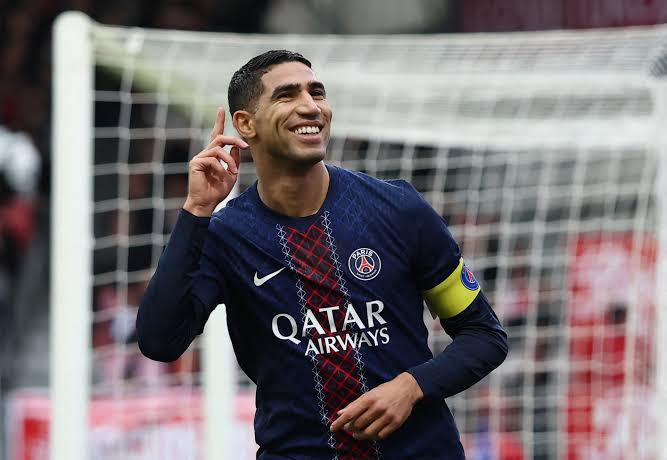
Modern football has produced few positional transformations as complete or as compelling as the evolution of the fullback role into one of the game’s most decisive attacking positions. Within that transformation, achraf hakimi stands as perhaps the most complete expression of what the modern attacking fullback can be — a player whose pace, technical quality, and positional intelligence have made him simultaneously one of the world’s most dangerous attacking threats and a genuinely reliable defensive presence. His journey from Real Madrid’s academy to the pinnacle of European club football tells a story about talent, opportunity, and the specific football culture that shaped him. Fans following Champions League football and international competition can find dedicated markets at dbbet skachat.
Early Life and Madrid Academy: Where the Foundation Was Built
Hakimi was born in Madrid in 1998 to Moroccan parents — a background that gave him the dual cultural identity that would later shape one of football’s most significant international allegiance decisions and that embedded him within the specific Moroccan community whose footballing tradition runs deep across the Spanish capital.
His entry into Real Madrid’s La Fábrica academy at age eight placed him within one of European football’s most demanding development environments — a system that simultaneously provides elite technical coaching and imposes competitive pressure that most young players cannot sustain across the years required to reach the senior squad’s consideration. The academy’s demands — technical precision, tactical understanding, and the psychological resilience required to compete against peers of exceptional quality for limited progression opportunities — shaped the competitive character alongside the technical foundations that his professional career has subsequently expressed.
What distinguished Hakimi within this elite environment was the specific combination of qualities that made him identifiable as genuinely exceptional rather than merely very good among exceptional peers. His pace — explosive acceleration whose competitive advantage is immediately legible — combined with the technical control that allows high-speed running with the ball to produce genuine attacking threat rather than simple ball-carrying that organized defenses can contain. These qualities, present from his earliest academy years, created the foundation that subsequent coaching has refined without needing to fundamentally reconstruct.
The Borussia Dortmund Loan: International Breakthrough
Hakimi story reaches its first major inflection point with his loan move to Borussia Dortmund for the 2018-19 and 2019-20 seasons — the decision that transformed a promising Real Madrid academy product into an internationally recognized performer whose qualities European football’s broader audience could evaluate across two full Bundesliga seasons.
Dortmund’s system under Lucien Favre, and subsequently under Edin Terzić, provided the specific tactical framework within which Hakimi’s attacking qualities could be expressed at maximum intensity — a team that built substantial portions of its offensive play through wide areas and that valued fullbacks capable of functioning as genuine attacking threats rather than defensive specialists who occasionally ventured forward.
The Bundesliga’s specific characteristics — the pace of play, the space available in transition, and the quality of opposition that provided genuine competitive tests without the Champions League environments that would have exposed developmental limitations prematurely — suited his development needs precisely. His performances across both Dortmund seasons — the goal contributions, the directness in one-on-one situations, the crossing quality delivered at pace — created the competitive record that transformed his market value and his professional trajectory simultaneously.
Inter Milan and the Serie A Transformation
His move to Inter Milan in 2020 placed him within Antonio Conte’s tactical system — a manager whose specific demands on fullback positioning and work rate created an environment where Hakimi’s qualities were simultaneously maximized and systematically tested across both defensive and attacking phases in ways that Dortmund’s system had not fully demanded.
Inter’s 2020-21 Serie A title — the club’s first in eleven years — was built substantially on the attacking contributions from fullback positions that Hakimi and Iván Perišić provided. The specific statistics from that championship season — the goal contributions, the distance covered, the defensive recovery runs — reflected a player operating at a level that the transfer market had not yet fully priced before his arrival and that his performance record across the season comprehensively confirmed.
The single Inter season’s brevity — his subsequent move to Paris Saint-Germain following Inter’s financial difficulties — meant that what Conte’s system might have developed across multiple seasons remained partially unexplored. The partnership with Conte that appeared capable of producing sustained excellence was interrupted by financial circumstances outside either party’s sporting control.
PSG and Champions League Football
Paris Saint-Germain’s acquisition of Hakimi provided the Champions League competitive platform and the financial structure that his market value required — placing him within an environment where his qualities could be expressed against Europe’s elite opposition across the tournament that defines career legacies for players of his profile.
His PSG years have demonstrated both the ceiling of his attacking qualities — the specific combinations with creative midfielders and forwards that his overlapping runs and crossing ability enable at the highest competitive level — and the defensive demands that Champions League knockout competition places on fullbacks whose attacking contributions sometimes create recovery positioning challenges that organized opponents exploit.
The development of his defensive game within PSG’s competitive context has been the specific area where hakimi news coverage has most consistently evaluated his development — assessing whether the complete fullback profile that his attacking excellence demands as complement has been consistently achieved or remains the developmental frontier that his career continues working toward.
Morocco’s World Cup Journey: A National Icon
The 2022 FIFA World Cup in Qatar delivered Hakimi’s most significant international moment and arguably the defining performance of his career to date — Morocco’s historic run to the semi-finals, becoming the first African nation to reach the last four of a World Cup, in which his contributions were central to the tactical organization and transitional quality that Walid Regragui’s team expressed throughout the tournament.
His penalty against Spain in the round of sixteen — the audacious chip that eliminated one of the tournament’s pre-match favorites — became one of Qatar 2022’s most discussed individual moments, combining technical audacity with psychological composure under the specific pressure of a World Cup knockout shootout in a way that revealed the competitive character that his club career had been building across the preceding years.
Morocco’s World Cup achievement carried significance for African football that extended well beyond the tournament results into what it demonstrated about the continent’s competitive ceiling — and Hakimi’s central role in that achievement connected him to a national sporting narrative whose importance to Moroccan identity and African football’s global standing will resonate across decades of subsequent reference.
The Complete Fullback: Technical Profile
Analyzing what makes Hakimi genuinely world-class rather than merely very good requires engaging with the specific technical qualities whose combination creates a player that tactical systems are designed around rather than simply accommodated within.
His pace — measurably among the fastest in professional football — creates attacking threat that defensive systems must account for even before he receives the ball, pulling center backs and opposing fullbacks into positioning decisions whose resolution creates space elsewhere that his teammates exploit. The crossing quality delivered at this pace — the ability to arrive at the byline with control sufficient to execute an accurate delivery despite the physical demand of the run that preceded it — is genuinely rare among players of his speed profile.
Defensively, his recovery pace — the ability to return to defensive positions after attacking contributions through sheer acceleration — compensates for the positional exposure that aggressive attacking fullback play creates in ways that less physically gifted players of similar tactical approach cannot manage. This recovery capacity is what separates genuinely complete attacking fullbacks from players who provide offensive value while creating defensive vulnerabilities that opponents regularly exploit.
What Hakimi’s Career Represents for African Football
Hakimi’s development from a Madrid-born Moroccan community product through Real Madrid’s academy to world-class status at PSG and national hero status with Morocco tells a story about African football’s global footprint that traditional metrics of continental competition performance do not fully capture.
The generation of players he represents — African-heritage footballers developed within European academy systems who have chosen to represent African national teams rather than the European countries of their birth — has transformed the competitive quality of African international football in ways that the Morocco World Cup performance demonstrated most visibly. The tactical sophistication, physical preparation standards, and competitive experience that European club football provides, combined with the genuine national identification that these players bring to African national team environments, creates competitive combinations whose ceiling Africa’s football development is still exploring.
His career’s ongoing development — the Champions League chapters still to be written, the World Cup cycles that will further define his international legacy — represents exactly the kind of compelling ongoing narrative that football’s ability to produce genuine sporting stories across entire careers provides to audiences engaged enough to follow the full arc rather than isolated moments.
